You’ve spent months perfecting your prototype, and the first production run is on the horizon. All that’s left is to sell it…and that’s often where things get complicated.
In hardtech, you can’t afford to course-correct after you’ve started your sales efforts. These cycles are long, and production runs are expensive. And poor positioning can set you back a year, which is precious time for a startup like yours.
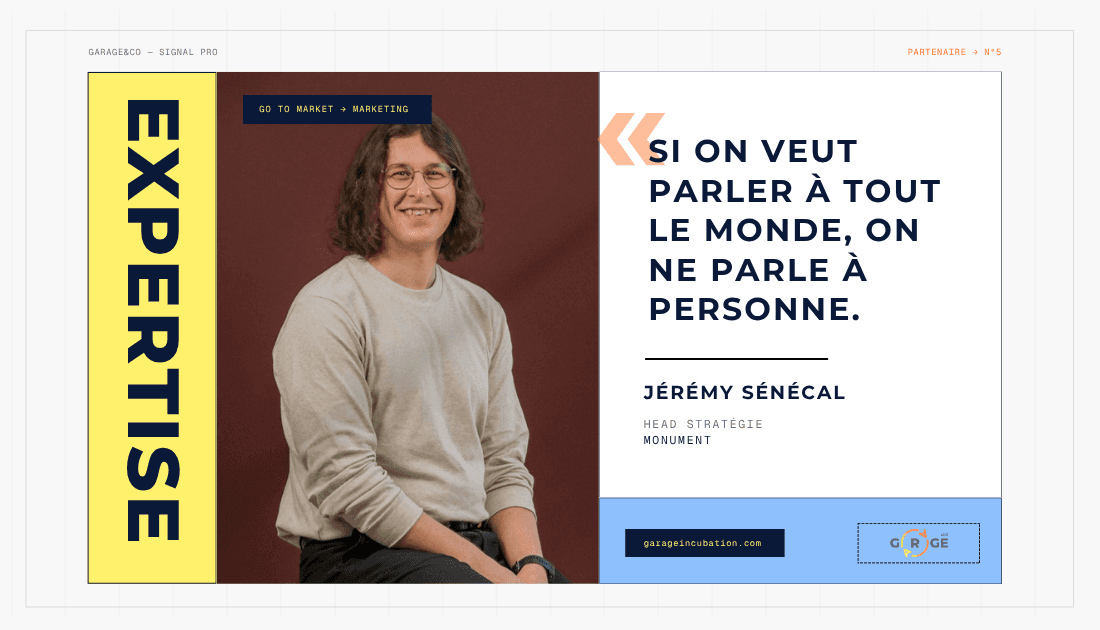
To better explain the importance of a solid go-to-market (GTM) strategy, Jérémy Sénécal, Head of Strategy at Monument, led a workshop. Jérémy has spent years helping businesses in a variety of sectors, including agri-food, construction, textiles, and consulting services, define their positioning and messaging.
So we've summarized the key points of this workshop for you.
Marketing is about intuition AND data
Every business decision is based first and foremost on a hypothesis. And in marketing, this is even more true. Research, therefore, serves to test these hypotheses before investing time and money.
The classic mistake made by tech founders is to rely solely on their intuition and the technical superiority of their product. But the opposite is just as true. Waiting for perfect data before taking action will delay the moment when you reach out to customers and validate whether there’s interest in your solution.
The right approach is a cycle: ask a question, formulate a hypothesis, gather information, analyze the results, and then decide whether to move forward. And you repeat this for every strategic decision. The goal is to reduce uncertainty.
And this cycle doesn’t necessarily require a large budget for exhaustive surveys or commissioned market research. If you don’t have money, all it requires is time.
Several sources offer free secondary data that’s relevant for building a picture of the situation: Statistics Canada, Google Trends, customer reviews of your competitors, forums, and Reddit.
Afterward, semi-structured interviews, over coffee with a small number of key people (between 8 and 12 is enough), will give you the “why” and the exact language your customers use.
Not everyone is your customer
“If you try to speak to everyone, you end up speaking to no one.”
A message designed for everyone won’t resonate with anyone. This is one of the simplest truths in marketing and communications.
And the consequences of a message that’s too broad are real: it will reduce the impact and effectiveness of your sales efforts, which are scattered across poorly qualified prospects, making it difficult for you to stand out from established competitors.
You must therefore choose a starting segment, your ideal customer profile (ICP), and build your primary messages around them. Always keep in mind that secondary targets and influencers gravitate around this ideal customer. In short, always consider the people around them: those who buy, those who make decisions, or influence, and even those who might stand in the way.
For a hardtech company, this distinction is crucial, since your end user isn’t always the one who signs the check.
For example, on a farm, the farmer uses your sensor, but the agricultural consultant, the distributor, or a neighbor who has tried it all influence the decision and may even recommend purchasing your solution over a competitor’s.
That’s why your secondary messages must also speak to these influencers.
B2C, B2B, B2G: Three Types of Sales, Three Approaches
The approach to persuasion changes completely depending on the type of sale.
B2C: The buyer makes the decision, sometimes in consultation with their household. The cycle ranges from a few minutes to a few weeks. Reviews and warranties provide reassurance.
B2B: The executive or budget manager makes the decision, but finance, IT, and procurement departments may block the process. The cycle lasts 3 to 12 months. A quantified return on investment, a customer case study, or a pilot project is expected.
B2G: Management or elected officials make the decision, often through a competitive bidding process. The cycle ranges from 6 to 24 months, depending on the fiscal year. Compliance, public references, and pilot projects carry significant weight.
Jeremy’s rule: The closer you get to B2G, the less the advertising message matters and the more evidence becomes important.
In addition to the type of sale you want to make, your product must be tailored to the type of consumer you’re targeting.
The heavy user is familiar with the category and is already satisfied with the current offering. To reach them, identify the pain point that their current provider isn’t addressing.
The light user buys based on context or promotions. To engage them, test different purchasing occasions to find their tipping point.
The newcomer category is often the target for innovative products. Although it takes more time to educate them and confirm that they understand the need before testing the message, they have high long-term value potential.
In short, each strategy must be tailored to the customer you want to reach. And that’s not even counting the differences across industries. That’s why it’s so important to do your research thoroughly and to test your approach.
Measuring Genuine Interest: What It Costs the Customer
Saying “I’d buy that” in a survey isn’t proof, because there’s no real commitment. These are the limitations of collecting primary data.
On the other hand, to demonstrate interest in your product, evidence of traction is attainable, even if these actions will cost the customer something before they pay the actual price of the product.
The spectrum of possible customer engagements ranges from signing up for a newsletter, which requires them to share their contact information, to scheduling a meeting, then signing a letter of intent, and finally making a payment. This is the challenge of your marketing efforts: always aim for the next level. The higher you go, the more tangible the proof becomes, and a paid presale or pilot is worth a thousand “I’m interested” responses from a survey.
Within your company, this is also what your metrics should reflect
Define your cost per conversion
Determine the customer’s lifetime value
Track the actual efforts required to reach each segment.
These figures prove that your message is attracting the right people at a sustainable cost. Finally, to demonstrate traction, use this simple formula: number + target + action + timeframe. For example, 150 consumers (number) aged 55 and older (target) signed up for the waitlist (action) in less than 14 days (timeframe).
What a startup can do right now, at little cost
Monument suggests a four-step process that requires a small budget:
Listen and observe: Assess where you stand relative to your competitors (points of disruption, parity, and differentiation), read their customer reviews, and take note of the vocabulary used by your target audience.
Ask questions: Conduct a short survey, followed by interviews, always asking this question: “Would you like to stay informed?”
Test: Choose two or three messages focused on your points of differentiation to see which ones resonate with your target audience, either through organic posts or on a landing page, with sign-ups as the goal.
Engage: Follow up with interested prospects through a demo, a pre-sale, or a pilot program to gather concrete evidence of interest.
Once you’ve completed these four steps, which may take several weeks or even months, and your message has proven effective, only then should you use paid advertising (Meta Ads, Google Ads) to amplify it.

Who is Monument?
Monument is a strategic creative agency with offices in Lévis, Thetford, Saint-Lambert, and Sainte-Marie. It supports businesses in brand strategy, digital marketing, video production, and graphic design. For more information: [agencemonument.com (opens in a new tab)] (opens in a new tab)