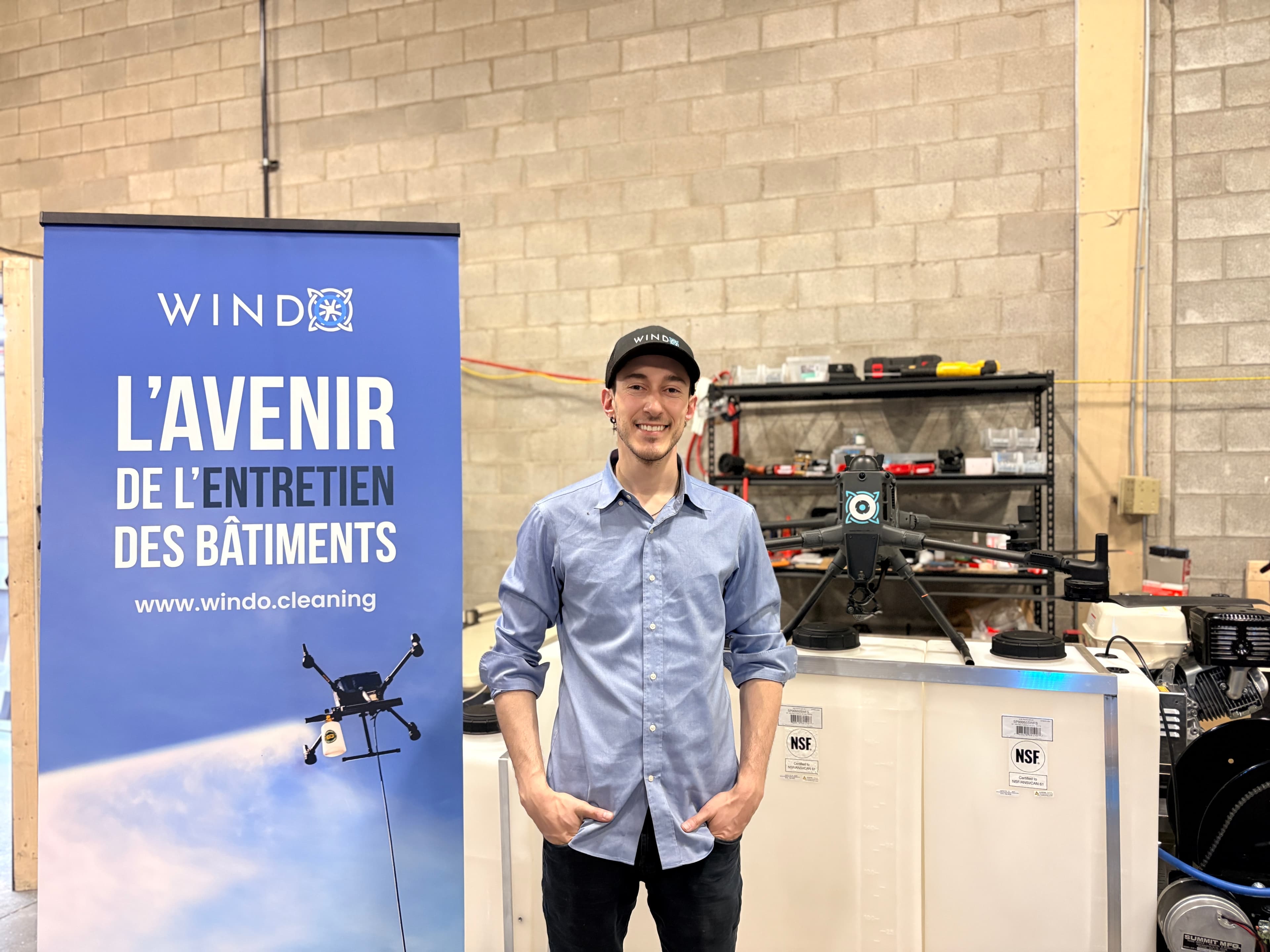
There are problems we notice without really paying attention to them, such as washing windows in high-rise towers. This arduous and risky work was seen as an inevitable part of life for building managers.
Sébastien Méthot and Émilie Normand decided to challenge that assumption. So, while at the École de technologie supérieure (ÉTS) and immersed in the world of drones at Dronolab, they came up with a simple solution: replace humans working at heights with a drone.
The result is WINDO and its turnkey WINDOSMART system, which is now transforming commercial window cleaning, one tower at a time.
Let’s discover this changemaker who is rewriting the rules of a trade as old as windows themselves.
The problem: A Dangerous Job to Tackle
High-rise window cleaning is one of the most demanding jobs in the building maintenance industry. Workers operate dozens of meters above the ground, exposed to the elements, using heavy equipment and subject to strict occupational health and safety requirements. It’s easy to imagine that recruiting for this type of job is also difficult.
For building owners and window-cleaning companies, this translates to:
high operational costs associated with specialized labor,
cleaning frequency limited by human constraints,
a constant risk of accidents, despite protective equipment,
and a reliance on an increasingly scarce workforce.
It was against this backdrop that Sébastien and Émilie began asking themselves the right question: what if we used machines to clean instead of people?
The solution: an aerial cleaning rig designed from the ground up
At the heart of the WINDOSMART system is an industrial-grade drone connected to the ground by a lightweight hose that delivers water and soap to the cleaning head. This design, known as a “tethered rig,” elegantly solves two major challenges faced by autonomous drones: battery life and water-carrying capacity. By supplying the drone from the ground, WINDO overcomes flight time limitations and can operate continuously across an entire facade without interruption.
The cleaning process consists of three distinct stages.
First, a high-pressure rinse dislodges dust particles, pollution, and mineral deposits.
Next, a soapy solution, formulated specifically for high-rise glass surfaces, is applied to remove organic and atmospheric residues.
Finally, a final rinse with pure water, which is filtered and demineralized by WINDO’s proprietary system, ensures a streak-free, residue-free finish on the glass. The pure water leaves nothing behind: no limescale, no film, and no need for corrective manual cleaning.
It allows a team to reach areas inaccessible to suspended platforms or aerial work platforms, all without a single technician ever leaving the ground. A single operator, a unified remote control, and a system that integrates navigation, pumping controls, and route planning assistance.
The result is a system capable of covering an area 2 to 4 times faster than a traditional crew, reaching areas inaccessible to suspended platforms or aerial work platforms, and doing so without a single technician leaving the ground. A single operator, a unified remote control, and a system that integrates navigation, pumping controls, and route-planning assistance.
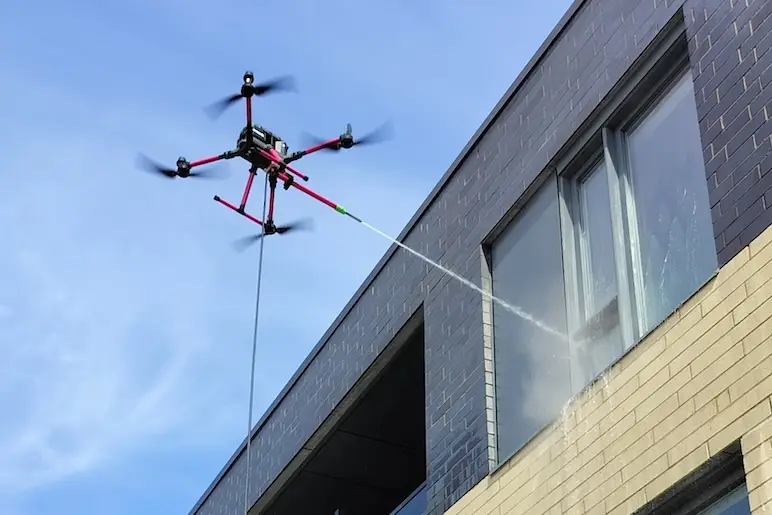
A WINDO drone in action
The risk: learning on the fly, literally
However, the early versions of WINDO didn’t look anything like what we see in the field today. During the first drone-based cleaning operation, Sébastien was operating the drone himself in the field, using a drone with an improperly calibrated payload and a pressure system that was still under development. These early customers could be described as true pioneers; at the time, the revenue barely covered the cost of cleaning supplies, with no additional profit margin.
Yes, the early trials were dangerous and the results uncertain, but they were necessary to understand how to better calibrate the drone’s operation. Every job site was a lesson, every mistake an improvement. The startup learned to fly by testing its product under real-world conditions, and this calculated risk laid the foundation for everything that followed.
They even explored a possible foray into drone-based painting, before running into construction industry regulations that shut that door. This detour brought them back to their original idea: mastering drone-based window cleaning, and doing it better than anyone else.
Ensuring Growth by Bootstrapping and Pivoting at the Right Time
With an initial investment of $15,000 each to purchase equipment, Sébastien and Émilie achieved the feat of bootstrapping their growth for three years, without venture capital and without external dilution. They built their reputation, wash after wash, building after building.
Over the years, the only dilution they allowed was in favor of their employees. This deliberate choice helped align the team around collective success and strengthen the commitment of those who keep the business running day to day.
Then, in 2024, a major strategic pivot: rather than franchising their service model, WINDO chose to sell its technology. Under the WINDOSMART brand, they now market a turnkey system designed for window cleaning companies, which includes a compressor, a pressure washer, a custom water filtration system, and proprietary connectors that form the core of WINDO’s trade secret.
Currently, the lead time from order placement to delivery is one week, but they already have plans to further improve this exceptional turnaround time to just a few days at most.
Why WINDO Is a Changemaker
WINDO doesn’t operate in a glamorous market. Window cleaning doesn’t make tech headlines or attract venture capital firms on the hunt for their next unicorn. But that’s precisely why their approach is remarkable.
By choosing to master the entire value chain, from service delivery to the technological product, WINDO has built something rare. They have proprietary expertise rooted in real-world experience, impossible to replicate in a lab. Every component is the result of three years of learning under real-world conditions.
What Sébastien and Émilie have realized is that a business that’s difficult to execute is also difficult to copy. And that the real barrier to entry isn’t patented, it’s built one tower at a time.
What we did to help WINDO
At Garage&co, we support companies like WINDO by making their strategic plans actionable on a day-to-day basis. Through close, personalized guidance, we help founders translate their vision into concrete actions and implement them, building on the support they received from HEC Montréal’s La Base entrepreneuriale and funding from Desjardins and PME MTL.
In 2025, WINDO had its best year yet. 45 buildings were cleaned, each up to 20 stories tall, with repeat customers and demand exceeding their own delivery capacity. It’s the kind of problem every startup wishes it had.
We continue to support the team through their pivot to WINDOSMART, as sales grow, Quebec’s leading window-cleaning companies adopt the solution, and WINDO begins to look toward Ontario, the rest of Canada, and the United States.
And since WINDO is developing aerial mapping technology that works without GPS, they’re already envisioning applications beyond window cleaning, particularly in military applications. What Sébastien and Émilie built to clean building facades could very well, in the near future, be used in ways no one initially anticipated.
That, too, is the strength of a supportive ecosystem: helping companies see opportunities they thought were out of reach on their own.