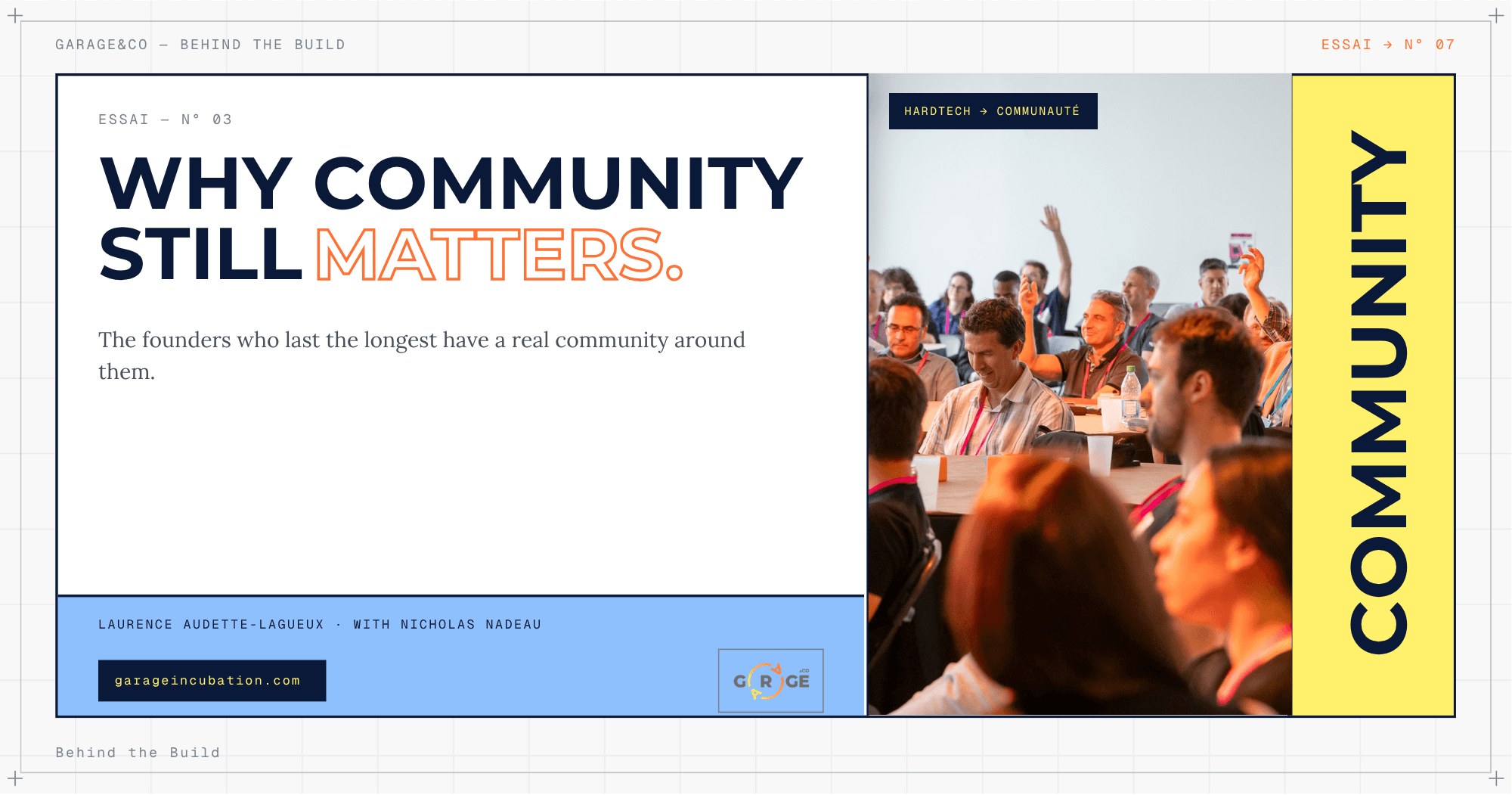
Written by Laurence Audette-Lagueux, General Manager at Garage&co, with the contribution of Nicholas Nadeau, Co-founder & CTO at Onix and president of the Board, Garage&co
In the past few weeks, I've had several conversations with people who entered the startup ecosystem around the same time I did, somewhere around 2015, and who have since scattered into different cities, sectors, and jobs. All of us started the same way, as community builders in coworking spaces, on Slack channels, and at meetups that nobody was paid to organize. Our conversations bent back toward the same place: the grassroots movement we came up in still matters, and in some ways it matters more now than it did when we were living it.
What those conversations kept returning to was how it felt at that time. The pizza was cold, and the beer was room temperature, and the room was full anyway, because we loved listening to founders tell their failure stories and watching engineers show off hacks that had no business working. We were ambitious and having fun, and nothing about those two facts felt contradictory at the time. We came for the people and stayed for the feeling of being part of something being built in real time by everyone in the room at once.
AI CAN’T REPLACE SERENDIPITY
When I brought those conversations to Nicholas Nadeau, the president of our board at Garage&co, who spent those same years building hardtech companies and the communities around them, the idea for this article followed within minutes, and we decided to write it together.
What we’ve been trying to understand since is: why that feeling has become so hard to find, and what it would take to build it again. The question feels more urgent now that AI can answer most of the technical questions a founder once carried to a meetup, because what a room full of people offers was never really the information: it was the chance introduction, the future co-founder, the investor who happened to be standing by the coffee. The knowledge has moved online, and the serendipity has stayed exactly where it always was.
Community is the structure of belonging
Two books I read this summer gave me better language for what those rooms had, and they are the other reason this essay exists. The first is Peter Block's Community: The Structure of Belonging (2008), which argues that belonging carries two senses at once: you belong to a community the way you belong to a family, meaning you are of it, and you belong to it the way you belong to a co-op, meaning you own a piece of it and the ownership obliges you. A community becomes real, in Block's telling, at the moment its members stop consuming an experience that someone else produced and start acting like owners of the thing itself, and that shift happens in small groups, around tables where everyone speaks: "the small group is the unit of transformation," he writes.
The second book is an oldie: Brad Feld's Startup Communities (2012), which took that intuition and turned it into ecosystem mechanics. His Boulder Thesis holds that entrepreneurs must lead the community, that the commitment must run twenty years at a minimum, that the door must stay open to anyone who wants to participate, and that the entire stack: founders, mentors, investors, employees, service providers, government, must be engaged in it together. Reading him this summer, my memory kept softening one detail: the rooms I knew were led by whoever wanted most to be part of something, which meant coders, community builders, early employees, and tech lovers as often as founders, people who showed up for the belonging first and discovered the business reasons later. Where Feld seems most right to me is on the timescale, because twenty years is exactly the kind of horizon a community deserves, and it is a horizon you can only hold if the thing is a pleasure to sustain.
Paul Graham completes the picture from inside a company: startups grow by doing things that don't scale, and building the early community around your work is one of those things. Y Combinator's most durable product is its alumni network, and what powers that network is a cultural norm of founders helping each other for free, on the assumption that someone will help them next.
Hardtech founders need community (more than software does?)
A software founder can build alone for longer than she should, but a hardware founder runs out of road much faster, and the reasons are practical. Hardtech timelines stretch from 2 to 10 years between prototype and first production run, and across that span, a founder will go through 3 to 8 prototype iterations, hit 2 or 3 regulatory inflection points, and absorb at least one supply chain crisis that appeared on nobody's roadmap. In three years, I have never watched a founder solve one of those problems alone; they get solved by calling someone who has lived through a similar one, and that person takes the call because you sat next to each other at a meetup two years earlier.
Nick lived this at 1X, where humanoid robots were a fringe idea long before they were an industry, and where the team kept showing up anyway (at Silicon Valley Robotics, at IIT in Italy, at ETH Zurich) because connecting the few communities that existed was how a fringe idea found its peers. The effect compounds with the difficulty of the technical work, the length of the timeline, and the scarcity of public peers in a given sector, which is a way of saying that hardtech founders need community most of all.
If the community doesn't exist, build it
The hardest lesson we've learned about community is that the room you need rarely exists yet, and that it appears when someone decides to build it rather than when a strategy calls for it.
We yearn for belonging, and we need to find our way back to building
Montréal claims the title of top deep learning city in North America, and good technical meetups back the claim, from Python to AI Tinkerers to React to generative AI. None of them, though, put founders on a stage in front of investors with the pure capitalist purpose of helping early-stage AI startups raise money, so Nick and his co-organizers built the AI Salon to do exactly that, and within a year it had grown into one of the largest monthly tech gatherings in Canada. The day it stops filling a real gap, they'll pivot or kill it.
We ran the same play in hardtech with the Hardtech Innovators Meetups, our Hardware Meetup, which gathered 350 participants. We built those rooms because we wanted to be in them ourselves, and the fun is part of the design rather than a decoration on top of it, because a gathering that people love attending is the only kind that survives a twenty-year horizon. The communities that compound are the niche ones, built around a mission that people recognize as worth their years, and the bigger that mission, the bigger the halo of people who gather around it.
A curated user community is an underrated moat
The same logic runs inward, toward your own customers, users, and earliest believers. Curating a community around your product is one of the most underrated moats in hardtech, and we push our founders toward it early, as a research method first and a marketing tactic a distant second. We do that because the first 50 to 200 people who care enough to join a Slack or drive to a meetup will tell you what to build, introduce you to your first pilot customers, and write the strongest reference checks an investor can ask for when you finally raise.
Nick saw this from the inside at AON3D, where the most valuable conversations happened on additive manufacturing forums, where obsessed engineers traded notes for free while enterprise customers were buying industrial 3D printers for parts headed to the ISS and the Moon. The company grew by becoming the bridge between those two worlds.
Founders sometimes assume their product is too technical, too B2B, or too niche to build a community, and our experience points the other way: specialists have fewer places to find each other and hold tighter to the ones that exist. The medtech founders we've accompanied who built quiet communities of clinicians, regulatory experts, and early adopters are years ahead of those who didn't, and over time, the product improves, the sales cycle shortens, and the fundraise starts to feel like a lap rather than a climb.
What this means for founders
Find the community already running in your city or sector and show up at least quarterly. Each time, bring something useful each time, because communities reward contributors and forget consumers, and remember that the rooms worth your evenings look like small tables.
Build the community around your product before you think you need it. Start with 10 people, run it the way you'd run a serious advisory board, with a clear cadence, honest conversation, and no marketing layer, and give it 12 to 18 months to grow alongside the product.
Protect the fun deliberately. Set ambitious business goals for your company, and let the community itself meet for the pleasure of it, because an evening works when people love being there.