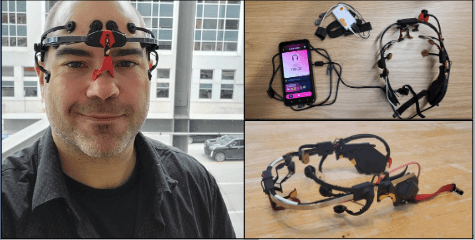
RE-AK Technologies, founded in Montreal in 2017, develops biometric glasses and software that measure people’s emotional and cognitive experiences in real-world situations, such as during a performance, a conference, or a scientific study. Event organizers and experience designers who use the technology gain a direct measure of what their audience is experiencing—whereas previously they had to rely on post-event surveys or focus groups.
To develop this product, Frédéric Simard, the company’s co-founder and president, changed technologies, formats, or markets three times, and he views each of these steps as part of the process rather than a detour. He currently teaches at ÉTS in addition to running RE-AK.
A First Product for the Video Game Industry
Frédéric Simard is an engineer (bachelor’s degree, ÉTS) and a neuroscientist by training. He spent five years pursuing a Ph.D. in neurophysiology at McGill University before dropping out to start his first company. He then worked in embedded systems, machine learning, and brain-computer interfaces before co-founding RE-AK with Patrick Marcotrigiano, who left the company in 2020. This dual expertise, with human physiology on one hand and the hardware used to measure it on the other, led him to directly measure the body’s reactions rather than infer them from what people report, and subsequently to design his own headset.
RE-AK got its start at Centech. Its first product, Nucleus-vizia, used a webcam to remotely analyze gamers’ facial expressions and a Muse headset to measure their cognitive state during gameplay, providing studios with insights into their reactions. The tool worked from a technical standpoint, but when it came time to sell it, Frédéric stumbled upon a question posed by a studio executive, who wanted to know if this tool would change the studio’s sales figures.
Frédéric didn't have an answer, because RE-AK was offering a way to measure emotion without linking it to a decision the studio needed to make. In his view, the context also worked against the company: the industry was experiencing a period of strong growth at the time, and studios whose revenues were increasing thanks to their usual testing methods had little incentive to take a risk in order to innovate.
Retail and the Issue of Rollout
Frédéric then turned his attention to the retail sector, where competition from online shopping was forcing retailers to justify in-store visits, so that measuring the in-store experience addressed a problem they themselves recognized. Interest was quickly confirmed by the adoption of the solution by Daniel Fournier Business Strategy (DFSA) and Stimulation Déjà Vu, but an initial pilot project in Montreal in 2019 showed that the rollout was not feasible, since it required installing and calibrating cameras throughout an entire store, a logistical challenge that prevented the project from being replicated from one location to another.
Frédéric concluded that the market existed, but that the method of capturing data made a viable business model impossible. This lesson shaped the next steps: the next version of the product had to be deployed in a matter of minutes, on-site, without any permanent installation.
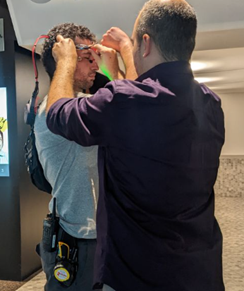
Installation of the Hermès headset
A headset designed, tested, and refined in the field
The current product replaces the camera with a wearable sensor and replicates the functionality of the Muse headset. The Hermès headset measures brain activity and facial muscle activation through contact, allowing it to gauge the mental state of a person moving around a space rather than being limited to a stationary position in front of a screen. It can be put on in seconds, without any wiring, and is part of Nucleus, a system that also includes analysis software and data processing infrastructure. The company designed it with the vision of eventually integrating it into smart glasses.
The shift from software to a wearable device has changed the nature of the business, as RE-AK must now design, manufacture, and maintain a device that hundreds of different people wear on their heads. The headset has evolved over the course of its deployments, and a recent version illustrates this evolution: the ear pads were redesigned because some participants experienced pressure points; the adjustment range was expanded to accommodate smaller heads; the plastic parts were reinforced to minimize breakage; and the headbands were given a new coating to prevent corrosion.
Each version also serves to collect data for the company’s emotional and cognitive models. And through these trials, Frédéric has learned to identify the contexts in which measurement provides value to the client, namely, those where the experience is difficult to observe otherwise and where objective evidence carries weight in a decision. He rules out cases where behavioral data is already easy and inexpensive to obtain, as well as those where an expert with twenty years of experience in the field already knows the answer.
How This Measurement Approach Is Changing the Events and Entertainment Industries
The change proposed by RE-AK lies in the timing and nature of the measurement. Until now, conference organizers and show producers learned about their audience’s experience through post-event surveys filled out by a minority of participants, and based on memory, whereas the headset records reactions during the experience, second by second. In 2022, the Montreal Convention Center was featured in Skift Meetings’ Innovation Destinations guide for its collaboration with RE-AK, in the next-generation technologies category.
RE-AK also conducts Mindscape Émotions, a study that maps audience reactions across different experiences, which the company describes as the largest survey of human experiences conducted using a biometric approach.
The company derives three products from the same measurements: physiological data used to design an experience, verify the impact of content, or adjust it as it unfolds; quantifiable results that the client can use in its own promotional communications; and, for each participant, a personalized profile of their reactions that they can share on social media—a highly successful offering. RE-AK prohibits certain uses, including discrimination based on emotions and the use of data in hiring or firing decisions, and it considers the data to remain the property of the people who provide it. As Frédéric puts it, biometric data is a personal resource, and each person can choose to use it in their own way.
A Self-Funded Model and Beyond
RE-AK has not raised any capital and funds its development through sales. Frédéric maintains a reduced teaching load at ÉTS, which provides him with a stable income and allows him to reinvest the company’s revenue into the team and research.
The company still derives the majority of its revenue from its one-time service offerings, but it now sells its headsets (27 units are currently in the hands of customers) and has just launched an innovative new business model that combines marketing, experiential intelligence, and revenue sharing, a model in which visitors now fund the RE-AK experience in exchange for personalized, shareable datastories. In the longer term, Frédéric wants the technology to become as commonplace as wearing glasses, which would transition RE-AK from one-time analytics contracts to a market trend analysis service.
Why Frédéric Simard Is a Change Maker
Frédéric Simard is changing the way the events and entertainment industry communicates with its audience. Creators of live entertainment experiences now have highly detailed insights into what participants are experiencing, and participants receive a “datastory” that engages them in the experience on a whole new level. This one-of-a-kind model is already in action and is proving its impact both in terms of the actionable experiential intelligence it produces and the revenue it generates.
He and his team achieved this by designing the technology themselves, from the neurophysiology he studied at McGill to the headbands and contact points of a headset worn by hundreds of people during an event, and refining it whenever real-world conditions revealed its limitations. Video games taught him that a metric must support a specific decision, and retail taught him that it must be deployable anywhere without permanent installation. Each of these lessons is reflected in the current product, which explains why Frédéric speaks of his journey as part of the result.
It also established early on the limits of what its technology can be used for, by rejecting applications related to hiring, firing, emotional discrimination, gimmicks, and novelty apps that prioritize spectacle over data quality, and by ensuring that participants retain ownership of their data. In a field where measuring emotions raises legitimate privacy concerns, these governance rules provide organizations that adopt RE-AK with a clear framework to present to their own audiences.