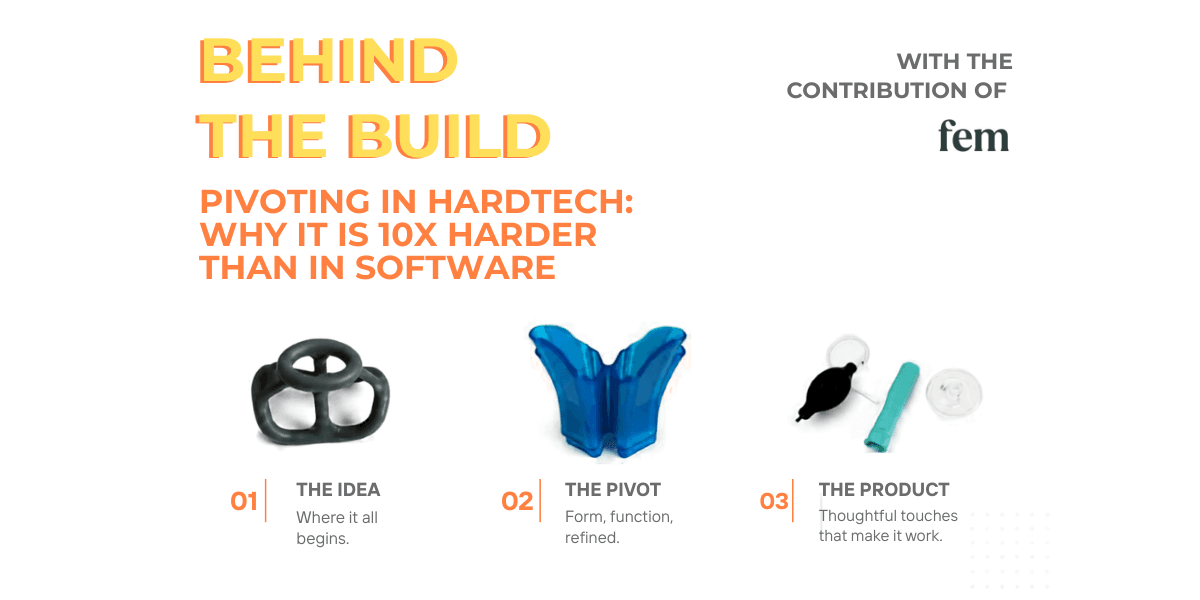
Negin Ashouri has spent close to seven years building femtherapeutics, and for most of that time, the product was never the same thing twice. I first heard the full story when she presented at one of our Hardtech Innovator Meetups.
femtherapeutics builds a custom-fit pessary for pelvic organ prolapse, a condition that affects roughly one in ten women and that most clinics still treat with a small set of generic geometric devices fitted by trial and error.
The company was founded in 2019, and its team spent close to five years pivoting the product. The last two years led to the version of femtherapeutics that now carries forward.
Across those years, the problem the company was solving stayed fixed while the product changed repeatedly. The device went through many iterations, several of them drastically different from the one before, while the question the team was answering never moved. Ashouri has been clear that the team's commitment was to the outcome of helping women with prolapse rather than to any particular design, which is the reason five years of change stayed inside the company's runway instead of exhausting it.
The pivot, briefly
The pivot, as it appears in the software-shaped narratives that have shaped the last fifteen years of founder education, most influentially in Eric Ries's The Lean Startup, is a refactor: a team reads the market, recognizes that the original direction is wrong, changes course, and emerges stronger for it.
The marginal cost of changing direction is low enough that many software teams treat pivoting as a normal part of the development cadence rather than a crisis. Hardware does not work this way: the gap between the two is a matter of category rather than degree, because a hardware company carries assets with a fixed shape, a fixed function, and a fixed relationship to the original product direction, and those assets do not travel cleanly when the direction changes.
The narrative travels poorly into hardware, because the assets of a hardware company are not portable in the way the assets of a software company are. Most hardware teams do not move through five years of change as cleanly as femtherapeutics did.
The five categories of sunk cost in a hardware pivot
A hardware pivot encounters a set of sunk costs that a software pivot simply does not have to absorb.
We walk our founders through these five categories before any major commitment is made, because the moment to think about pivot cost is before the assets exist, rather than after.
Engineering and design specialization
Hardware engineers are hired for specific technical domains and a pivot that crosses domains requires either retraining engineers who do not yet have the expertise, or rehiring against the new domain, or both at the same time.
Design work carries the same kind of cost: the months a mechanical and industrial design team spends converging on a form factor and a set of user interactions do not transfer cleanly to a different product. femtherapeutics cycled through several rounds of this, moving between in-house and outsourced engineering and assuming each time that the design was the problem. The team eventually found that the design itself was rarely the real constraint; the gap was an incomplete understanding of the underlying clinical question, a consequence of how little data exists in women's health.
Bringing in engineers with direct medical device experience changed the quality of the work, less because they arrived with the answer than because they made sure the foundations were right. Once the problem was genuinely understood, after the team acquired the right data and ran its own in-house user testing, solving it turned out to be far less complicated. It is one of the reasons we push founders to prove a direction before they commit a team to building it.
Tooling
The most visible category and often the largest. Production tooling is designed and built for a specific part geometry, and a pivot that changes the form factor, the materials, or the mechanical architecture renders the existing tooling obsolete. A typical injection mold costs $50,000 to $200,000 and takes six to twelve weeks to fabricate, while a complex multi-cavity tool or a die-cast tool can cost several times that amount and take months longer to build. Once a mold has been cut for a part the company no longer plans to ship, the capital that paid for it is gone, and the schedule cushion that the tooling was supposed to deliver is gone with it.
The surest protection against this category is to stay on flexible prototyping methods until the design has earned the commitment, which is the strategy the next section describes.
Inventory
Stock is a cost founders feel quickly because it sits on their balance sheet from the moment the purchase orders are issued. Hardware companies buy components and materials in advance of production, often in volumes that secure pricing or guarantee availability for long lead-time items. A pivot that changes the bill of materials leaves that inventory stranded, and component inventory that cannot be returned to the supplier, redirected to a different product, or sold to another buyer becomes a write-down on the next financial statement.
femtherapeutics is working through a version of this now, with a possible material change in one of its components. Rather than write the existing stock off, the team is redirecting it into testing, using the original material to complete validation work, then using those results to support the justification for the new material. The inventory still produces evidence the company needs, and the work already done on the previous material continues to count.
Supply chain relationships
This asset that took months to build does not transfer cleanly across product directions. Qualifying a supplier involves sample evaluation, process audits, reliability testing, and commercial negotiation, and the qualification work is specific to the part being qualified. A pivot that changes the manufacturing approach means rebuilding those relationships from scratch with new suppliers, with all of the qualification time that the original program already paid for once. Where the quality checks sit along that chain is itself a decision.
femtherapeutics chose to spend more on inspection earlier, on the reasoning that absorbing a cost upstream is far easier than discovering a defect in a finished device.
Regulatory certifications
These are granted to specific products and lose their validity when the product changes materially. A pivot that affects the design, the materials, the function, or the intended use of a certified product requires recertification, which can add anywhere from six months to two years to the timeline depending on the sector and the certification regime. In medical device and other regulated domains, recertification is often the single largest cost of a late-stage pivot, and it is the cost that founders most consistently underestimate.
femtherapeutics brought in a third-party quality and regulatory team to navigate certification rather than learning the path by trial and error. The cost is real and recurring, and the value is in the specificity: knowing exactly which steps matter for this device, in this regulatory regime. In a regulated environment, a late change does not only cost money,it can set a timeline back by years, which is why catching a problem before an FDA submission is worth far more than the spending it takes to catch it.
How to keep pivots affordable
None of this means that hardware companies should avoid pivoting. Markets change, customer needs are misread, technologies do not perform as the team expected them to, and the ability to recognize when a direction is wrong and change course is a valuable capacity in any industry. What it means is that hardware pivots require a different planning posture from the one that has been imported into hardtech from the software world over the past decade.
That posture is what let femtherapeutics spend five years changing the product without ever stranding the assets that make change expensive.
Prototyping technology was only part of what kept the cost of those years low. The larger part was a deliberate strategy of finding every cheap way to fail before committing to harder assets. femtherapeutics built an in-house testing capability that produced real feedback at each iteration: physical models of pelvic anatomy to evaluate fit and mechanical behavior, in-vivo testing protocols, and access to cadaveric specimens to validate device performance in anatomically realistic conditions. Each of those pathways compressed a feedback loop that would otherwise have demanded an expensive clinical setup or pushed validation later, to the point where a wrong answer costs the most to act on.
Defer hard commitments as long as the program can stand it. Tooling, long lead-time inventory, and exclusive supplier commitments are the most expensive assets to strand, and every additional week of design validation that delays those commitments is a week of optionality preserved. The Garage Readiness Level diagnostic we use with our founders is built partly to make this visible, by showing the team which dimensions of the program are still uncertain enough that hard commitments would be premature.
Design for adaptability where the cost of adaptability is low. Some design decisions are cheap to change after the fact, while others constrain every decision that comes downstream of them. Hardware teams that identify which decisions are load-bearing — modular architecture choices, interface standards, common enclosure platforms, software-configurable behavior — and treat those decisions with additional care preserve far more flexibility than teams that treat every decision as equally reversible.
Maintain a strong market signal throughout the development process. The most expensive hardware pivot is the one that arrives after production has already begun, and the surest way to avoid that pivot is to stay close to customer feedback throughout development by using prototypes and pre-production samples to validate market assumptions on a continuous basis. A signal caught at the prototype stage requires only a design change. A signal caught after tooling has been cut requires a write-down.
Understand which assets transfer across direction changes. Core technology developed around a real customer problem, team expertise built around a domain rather than a specific product, and customer relationships rooted in trust rather than in a particular SKU all survive direction changes far better than assets tied tightly to the original product. Knowing which assets in the company are portable, and which are bound to the specific product, shapes the set of directions a pivot can go in at a manageable cost.
We used AI to polish the text and make it flow better.