You’ve spent two years developing a respiratory sensor, an aquaponics system, or a monitoring device for people living alone. Your technology works.
Now, you’ve decided to talk about it on LinkedIn. You’re thinking about how to go about it, what to say… and what comes to mind? Not much.
This challenge gave rise to a series of workshops that the Monument agency led at Garage&co this spring.
Over the course of three sessions, each lasting about 100 minutes, members of the Monument team covered key topics in marketing communication: a brand’s purpose, digital presence, and paid advertising.
What emerged from these workshops is a series of clear actions that any founder can take this week. Let’s take a look at them together.
Start with the why, not the how
What sets Monument’s approach apart from other agencies is that they don’t start a strategy with tactics; they start with what Simon Sinek calls the Golden Circle—that is, the company’s “why.”
According to Laurent Cadoret, a copywriter at the agency, it’s easier for a hardtech startup to answer this question than it is for a consumer brand. You created your product because a great-aunt fell alone in her home, because patients lacked lung sensors, because food autonomy seemed fundamental to you…
Even at this stage, you’re not thinking in terms of sales, but rather in terms of purpose—the reason behind the creation of your company. That’s what motivated you to launch your project.
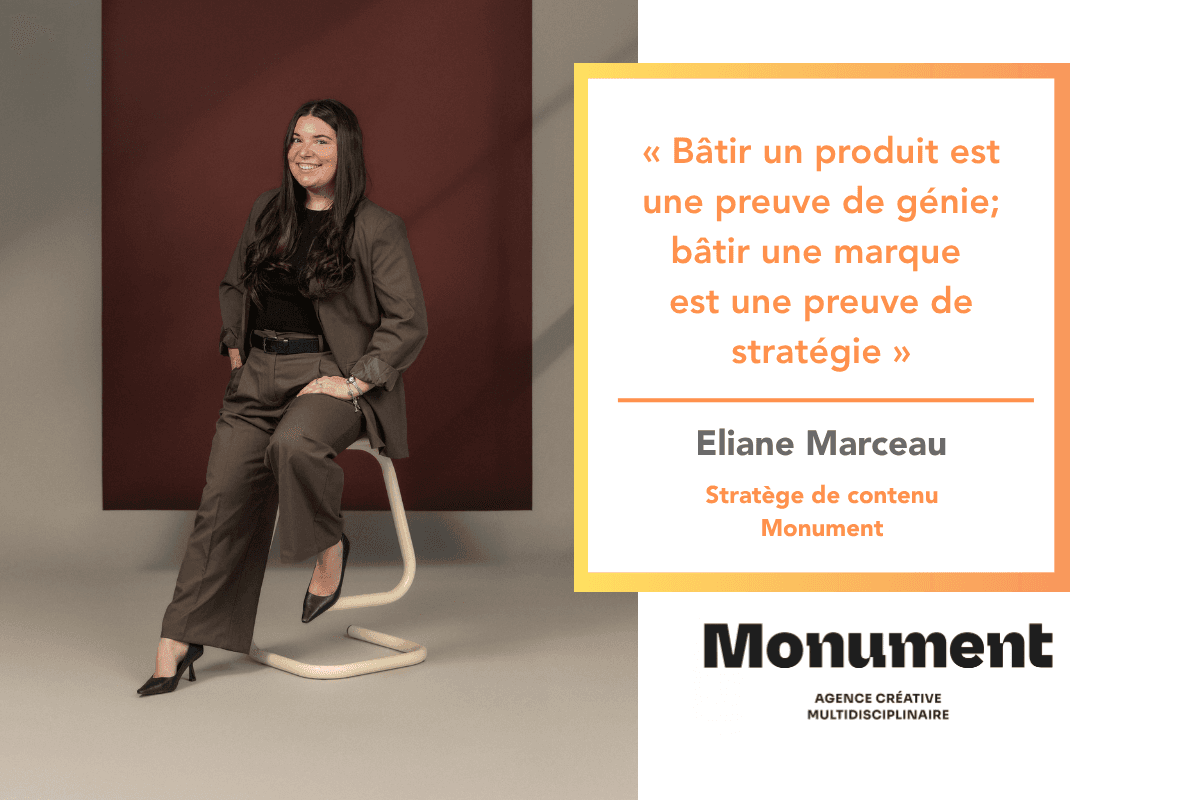
Éliane Marceau, content strategist at Monument, asks founders directly: “Why do you want to be known?” The answer shapes everything else: the tone, the platforms, and the type of content to produce.
You are your own best ambassador
In the hardtech sector, sales cycles are long, and buyers do their homework. Before signing with you, they’ll look up your name on LinkedIn. What they find, or don’t find, will influence their decision.
Monument emphasizes a well-documented dynamic: engagement is more natural from person to person than from person to company. The company page generates less organic reach than the founder’s personal profile. The strategy, therefore, is to post under your own name about what you truly know, to mention your company to generate visibility on its page, and then to gradually invite your network to follow it.
In practical terms, this means talking about your design decisions, your missteps along the way, and what you’ve learned on the ground: no running metaphors, but content that demonstrates you understand the problem better than anyone else.
On LinkedIn, a few practices can increase your reach without a budget:
post early in the week
tag relevant people in your posts
comment on other posts with your perspective.
Note that, generally speaking, the algorithm prefers original posts over reposts, and storytelling over ads!
Choose one or two platforms and stick with them
Monument also recommends not spreading yourself too thin. For a B2B hardtech startup, LinkedIn and Facebook cover most of the buyer’s journey. Instagram can be a good complement if the product has a strong visual component or if the founders want to document their development process.
Facebook, despite its aging reputation, remains the most widely used platform in Canada and is still relevant for building brand credibility over time. It works well for explaining the story behind the product, showcasing the team, and sharing Reels about technical features.
LinkedIn, on the other hand, plays a different role: it’s the tool for positioning yourself as an expert. A carousel explaining a technical issue, an anonymized case study, or a survey on the challenges faced by your target market are all types of content that generate engagement and build a reputation over time.
Pay for advertising, but do it smartly
William Trudeau, Digital Campaign Manager at Monument, led the workshop on the basics of paid advertising. This strategic tool offers numerous growth opportunities, regardless of industry, in both B2B and B2C contexts.
His first piece of advice is aimed directly at startups with limited budgets: don’t spread yourself too thin.
Indeed, performing well on an advertising platform requires an iterative process of testing and optimization. This learning curve slows down considerably if you try to be everywhere at once. That’s why, when resources are limited, you’re much better off centralizing your investments.
This approach leads to distinguishing between two very different investment strategies depending on the objective.
On the one hand, SEM (search engine marketing, such as Google Ads) allows you to capture a clear intent, which proves particularly effective for reaching a niche audience by targeting specific keywords related to a precise need.
On the other hand, SMM (social media advertising) seeks instead to capture attention by interrupting the user’s content consumption. Relying on targeting by demographics and interests, this approach offers an ideal platform for conveying a more complex message when an educational effort is needed to help users understand your services.
Before investing in advertising, it’s important to keep in mind that while campaigns are designed to generate clicks, they absolutely require an effective and strategic landing page to convert that traffic into leads.
This is where the dedicated landing page comes in: a page separate from the main site, stripped of any navigation menus to avoid distracting the visitor, which presents a clear offer, reassuring social proof (testimonials, partners), and a short form that focuses on essential information. The ultimate goal is to channel the visitor’s attention toward a single desired action.
Regarding the budget, William advises allocating the investment according to a specific rule: 70% for acquiring new audiences and 30% for retargeting people who have already visited the site or interacted with the brand. This structure allows you to prioritize acquisition to raise brand awareness among new prospects, while mapping out a complete and seamless path to conversion.
Finally, if the budget is tight, he reminds us that it’s better to dominate a single platform in a single region than to spread yourself too thin across multiple platforms with an insufficient budget.
A challenge for this week
Monument always wraps up its workshops with a practical exercise. The easiest one to do right away: write a LinkedIn post as a founder about what inspired you to start your business.
Who’s in?

Who is Monument?
Monument is a strategic creative agency with offices in Lévis, Thetford, Saint-Lambert, and Sainte-Marie. It supports businesses in brand strategy, digital marketing, video production, and graphic design. For more information: [agencemonument.com]