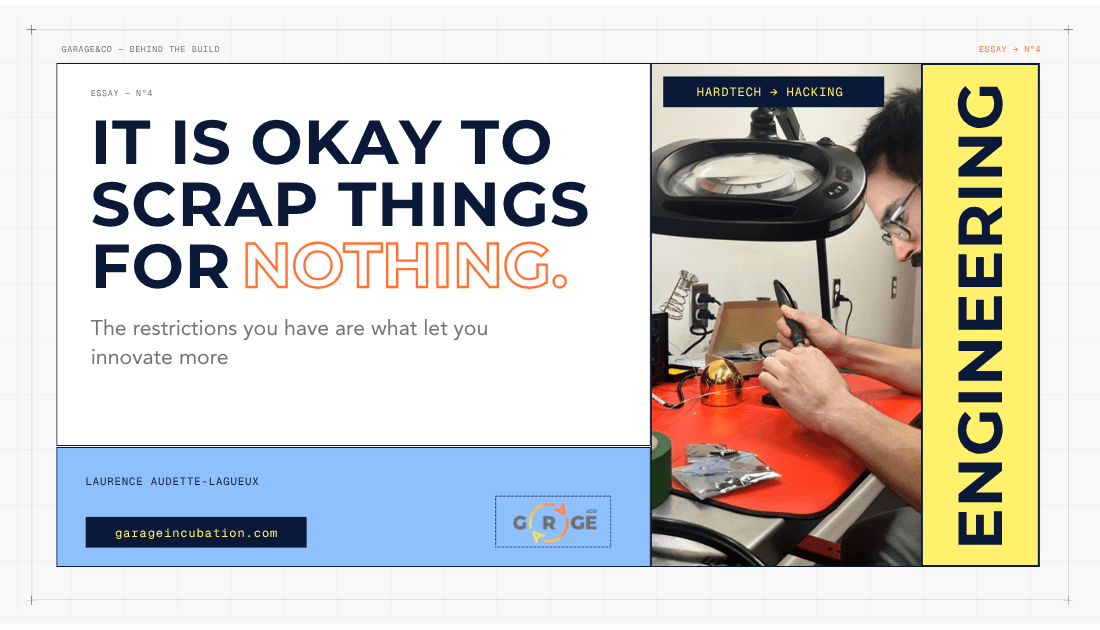
I have always loved a good hacking session, because it is usually where the magic happens. It is the moment a founder understands that they can actually build the thing themselves, and that there is a creative way to get it done on a dime. One of my favourite things to watch in the Lab is Arthur, our prototyping expert, sitting down with a founder and putting together something that works out of three wires and a chain bought at Canadian Tire. It takes the mystique out of the product, and you can see the founder recalculating in real time everything else that might be within reach.
Most of the hardware founders I meet are stopped by money long before they are stopped by physics. They believe serious hardware needs serious equipment, that serious equipment gets bought new, and that the quote sitting in their inbox is the price of entry.
Hacking, in a hardware lab, means getting the function you need out of parts that were built for something else. You pull a component out of a consumer product, you repair a machine somebody else wrote off, you mount three catalogue pieces into an instrument nobody sells. The work is sourcing and adaptation more than invention, and it asks for enough electronics and mechanics to diagnose something that shows up with no manual and no warranty.
Complex Things Can Be Built, and There is No Mystery in How
I sat down with Hugo McGuire, co-founder at eNUVIO, to talk about how he hacked together a two-million-dollar lab with fifty thousand dollars, a good saw and a lot of imagination.
Hugo has a doctorate in physics with a specialization in biophysics, and he started eNUVIO in 2016 with two co-founders from graduate school at Université de Montréal and McGill. They worked in electrophysiology, a technique everyone in their labs complained about because it was slow and fastidious, and they wanted microfabrication to make it faster for the researcher at the bench. That work needed instruments a company running on family-and-friends money had no business owning.
So they made them. A mask aligner holds a photolithography mask against a substrate with micron accuracy and sits at the centre of every microfabrication process, and a commercial one would have swallowed most of what they had raised. Hugo bought small optical components separately and mounted them into an aligner of his own, and the narrow wavelengths he needed came from LEDs anyone can order online rather than from a specialty lamp.
Researchers have been publishing designs like these for years and almost nobody in a startup goes looking for them. Joshua Pearce's Open-Source Lab gives full bills of materials for dozens of research instruments a small team can build for a fraction of catalogue price, and the Elsevier journal HardwareX peer-reviews open-source hardware designs the way other journals review results. Search there first and you sometimes find the instrument already built and tested. I still watch founders in industrial sensing get a quote for a speaker when the one they need sits inside a thirty-dollar device, held in by four screws.
eNUVIO rented before it built anything. Hugo knew ÉTS had a cleanroom, so he paid for access there to fabricate the first prototypes, and someone at the CHUM agreed to rent him a small cell culture space at a price a company with almost nothing could pay. He paid month to month, which kept the company free while the product was still changing. All of it happened because Hugo walked up to people and asked, and people in this milieu in Montreal still talk to each other, so the professor who cannot rent you a bench usually knows who can.
Machines work the same way, and the listings are public: federal surplus moves through GCSurplus, universities and hospitals sell off decommissioned equipment, and resellers list used laboratory instruments as biotech companies restructure. eNUVIO bought a system that came out of Valcartier when a facility there closed, a machine that had spent its previous life coating missile heads, at a price that reflected its condition. That first summer they hired eight interns from ÉTS and Polytechnique, gave each one a project, and spent the season putting the machines back into service. Hugo still uses that system regularly.
Do not let the shiny thing set your ceiling
eNUVIO's cleanroom sits at Dome Park, facing the Lachine Canal, which is nowhere anyone would think to look for one. When Hugo told me they had built it themselves, I said what most people say, that a cleanroom sounds impossibly complex, and he told me it is not that bad. Then he explained it to me in ninety seconds. Moore, Davis and Coplan wrote a whole book on that reflex, Building Scientific Apparatus, which has taught researchers for four decades to break an instrument into subsystems they can buy, adapt or make.
A cleanroom is controlled air: HEPA filters and fans across the ceiling pushing filtered air straight down, adjustable grilles along the side walls governing how it leaves, and a sealed envelope so nothing comes in without passing the filters. The envelope is where the money usually goes, and Hugo built his out of the heavy plastic sheeting sold for agricultural use, cheap by the roll and perfectly adequate at the surface. He still has photographs somewhere of the team up on metal scaffolding assembling it. When I said nobody had posted a YouTube tutorial for that one, he agreed, and then offered to make one.
The restrictions we had at the beginning are what let us innovate more: you find far more options when you cannot afford the obvious one.
Then he measured. ISO 14644-1 defines a cleanroom class by counted particles per cubic metre at specified sizes, so Hugo borrowed a particle counter from ÉTS and ran it inside the room they had assembled. The counts came back better than the McGill facility where he had done his postdoc, and he kept the borrowed counter for weeks, watching the numbers hold, before he trusted them.
A few years later a program sent a consultant through the lab, someone who had spent much of his career in cleanrooms. He looked around, guessed the build had cost around two million dollars, and then asked. Hugo added it up, machines included, and the number was about fifty thousand. Sam Zeloof does the same thing on a smaller scale, fabricating integrated circuits in his family's garage with scavenged and homemade equipment, and publishing every step.
What hacking actually costs
Hugo counts the cost in days rather than dollars : every workaround is a challenge he has to solve in his head and then with his hands, and those days are days he is not spending on customers or on the technology that is supposed to be the company. He calls the first years rough. He would do it again with the energy he had in 2016, he doubts he would take it on today, and he thinks it still works in 2026 for founders willing to go at it with a lot of grit.
I asked him what gives someone the nerve to build the thing instead of buying it. He said he was not sure whether it was guts or plain naïveté, and that he has been like this most of his life. His method is unglamorous: the team talks a problem through, everyone sleeps on it, and a couple of days later small ideas start surfacing. He says it is rare that they hit something they cannot get around.
When eNUVIO doubled its lab footprint this year, Hugo hired a contractor, because time had become the scarcer resource. They still build in-house regularly, and the reason now is flexibility: a machine they made themselves is one they can open up in two years when the process changes.
What this means for founders
Take something apart this month. A consumer device, a broken instrument, a listing on a surplus site. Founders who have opened a few enclosures stop seeing catalogue products and start seeing parts with prices attached.
Search the literature before you request the quote. HardwareX, Open-Source Lab, Building Scientific Apparatus. An afternoon of reading regularly replaces a purchase order.
Rent while your product is still changing, and ask a person rather than looking for a listing. University cleanrooms, hospital labs and shared facilities in Montreal rent by the month, and GCSurplus and the university decommissioning channels are worth watching for three months before you need them.
Borrow an instrument and measure the hack. A particle counter, a thermal camera, an oscilloscope, from the facility you used to rent from. Keep it long enough to see the numbers hold, the way Hugo did.
Decide in advance which two or three things you will buy new regardless of price. Anything that gates a customer deliverable, anything on the certification path (dispositifs médicaux, aérospatial et défense), anything where a failure would go unnoticed until late.
Garage&co · Hardtech Infrastructure · Québec · September 2026