You've built something that works : the demo ran smoothly, the arm moved, the mechanism did what it was supposed to do. And now, investors are interested in scaling your MVP to a mass-market product. But here's the question most hardtech founders don't ask early enough: is what you've built actually manufacturable at scale?
The gap between a working prototype and a production-ready system is one of the most underestimated challenges in hardtech. Unlike prototyping, scaling to production involves an entirely different mindset :
design decisions that felt practical at the prototype stage can become expensive once you're operating at volume;
a component that was easy to source for your first five units may have a 52-week lead time when you need thousands;
and, a motor spec chosen for its low cost may introduce vibration or precision drift that kills your product's reliability in the field.
In a nutshell, founders often underestimate hidden costs like tooling, certifications, and product returns, and they don't realize that every design mistake costs months of delay and tens of thousands of dollars.
This is especially true in the domain of motion control, and it's exactly where our new partner, Electromate, comes in.
Build vs. Buy: The Decision That Shapes Everything
At the core of most hardtech scaling challenges is a deceptively simple question: should you build this component yourself, or buy it from a specialized provider?
The instinct to build is understandable. It feels like it preserves IP, reduces costs, and keeps you in control. But the calculus is more complex than it appears. The make-or-buy decision involves assessing broader strategic implications, from operational efficiency to market competitiveness, across factors like cost, quality, capacity, core competencies, and risk.
For startups specifically, building a custom motion component from scratch means taking on the full burden of design validation, failure analysis, sourcing resilience, and ongoing maintenance. All of this while trying to move fast in a market that won't wait. Buying a purpose-built component from a proven supplier, by contrast, means leveraging decades of engineering refinement, validated performance data, and supply chain depth you couldn't replicate alone.
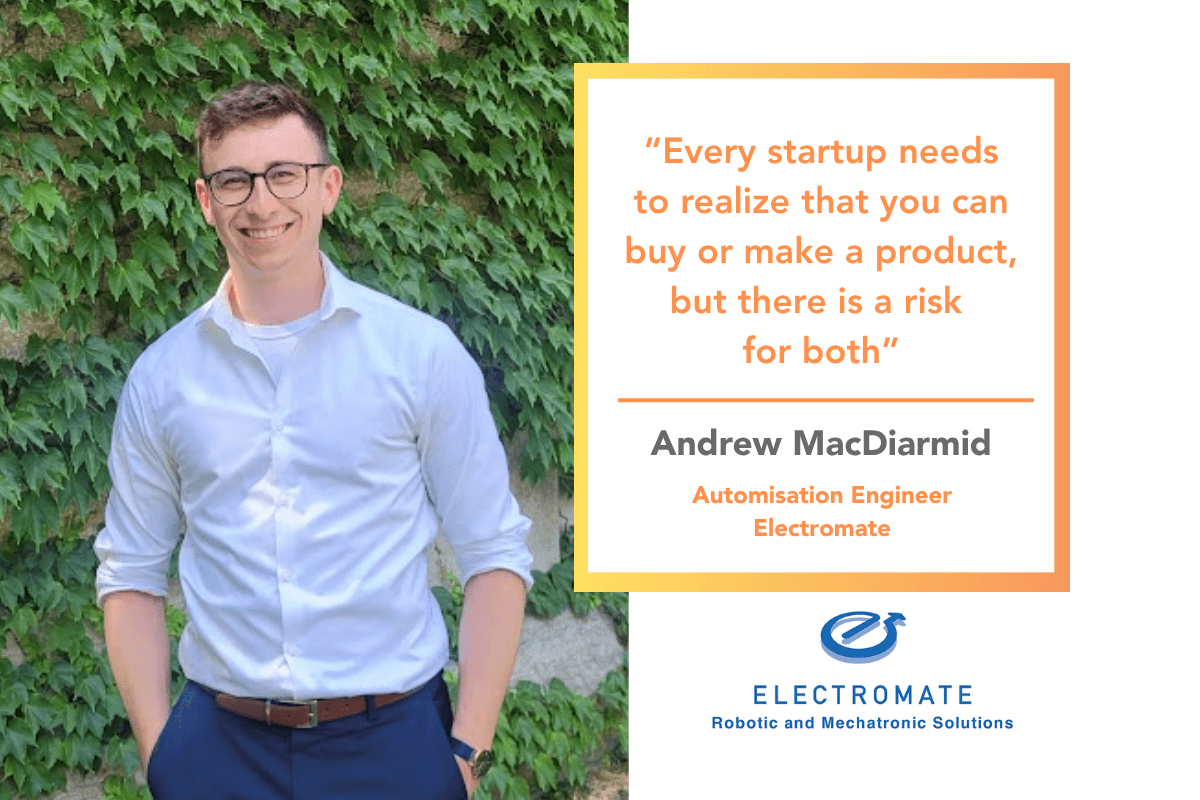
As Andrew MacDiarmid, senior engineer at Electromate, put it: "Every startup needs to realize that you can buy or make a product, but there is a risk for both, whether monetary or efficiency-wise." The key is making that decision deliberately, with eyes open to both the upside and the trade-offs.
Think Production Line, Not Prototype
One of the most actionable pieces of advice Electromate brings to early-stage founders is this: “when you're specifying your components, don't think about the 10 units you're building today, think about the 10,000 you'll need to deliver in 18 months.”
There are different advantages for different steps in the production cycles: a prototype optimizes for speed and proof, but mass production optimizes for repeatability, availability, yield, compliance, and scale. Those are fundamentally different optimization targets, and conflating the two is where startups run into trouble.
Electromate's approach is to encourage founders to start with a broader feature set and scale back from there, rather than starting minimal and having to re-engineer mid-stream. This matters not just for technical performance, but for supply chain resilience. Just imagine what can happen to your plan if a port closes across the globe or if allocation crunches from larger buyers freeze your production overnight. If your BOM is built around a sole-sourced component with no fallback, that can escalate quickly and cost you a lot.
Building with scalability and substitutability in mind from the start is the kind of strategic thinking that separates companies that ship from those that stall.
The Real Architecture of a Mechanical System
Motion control is a system, not just a single product. Electromate helps startups understand that building the right motion system means correctly specifying and integrating six interdependent elements: the motor, the drive or amplifier, the controller, the feedback device, the mechanical transmission, and the software.
Each choice affects the others. The wrong motor paired with an underpowered drive will underperform. A high-precision servo motor paired with a controller that can't process feedback fast enough defeats the purpose of the servo. And on the mechanical side, factors like alignment, rigidity, backlash, resonance, and coupling all interact in ways that aren't always visible at prototype scale, but become critical when the system runs continuously under load.
Motor selection alone illustrates the complexity: stepper motors are cost-effective for early prototyping but limited in precision and speed; servo motors offer closed-loop control and higher accuracy but come at a premium and require more sophisticated integration; linear motors deliver exceptional speed and performance for applications where every millisecond matters.
Getting this choice right, for your specific use case, at your specific production volume, is exactly the kind of decision where expert guidance saves time and money. And Electromate is some examples to prove they are doing the right thing for startups.
Examples of Hardtech Companies That Got It Right
The proof of concept isn't just theoretical. Electromate has been a component partner to some of Canada's most recognizable robotics success stories such as Kinova and Mecademic
Kinova Robotics built their Jaco2 robotic arm, a lightweight, assistive device designed to help disabled individuals perform daily tasks, around six flat brushless motors from maxon, moving through six degrees of freedom. Kinova chose maxon's EC flat motors for their compact form factor (critical for tight joint spaces), their efficiency, and their remarkably quiet operation, which was essential for a device designed to be as unobtrusive as possible for the end user. Electromate served as the Canadian technical resource connecting Kinova's engineering team to maxon's product line, and so bridging the gap between a design requirement and a production-grade solution.
Mecademic, another Canadian robotics company and Electromate partner, designs and manufactures what are considered the world's smallest and most precise industrial robot arms. They are assembled in Montreal using the highest quality components, and designed to integrate into any automation environment without additional training or software installation.
These are stories of teams that made deliberate, expert-informed component decisions early, and built systems that could actually scale.
What Your Startup Should Do Now
Before you commit to a motor, a drive, or a transmission strategy, invest time in precisely defining your motion requirements: What speed? What torque? What precision and repeatability? What duty cycle? What environment will this system operate in?
These specifications, which are often skipped in the rush to build a working prototype, are the foundation on which every downstream decision rests.
The second move is to get expert input early. The cost of a wrong component choice compounds over time. Catching a misspecification at the design stage costs an afternoon. Catching it after you've taken a production run can cost your company.
Electromate is available to help Garage&co startups work through exactly this kind of analysis : from sizing and selection to system integration and failure mode planning.
And if you're a student or early-stage engineer still building toward your first prototype, Electromate's Young Engineers Outreach Program is worth knowing about. The program offers Canadian university and college students access to servo and stepper motors, gearheads, and controllers at discounted prices or even donated free of charge, along with expert support from knowledgeable product specialists, and approved projects get promoted through Electromate's communication channels. It's one of the more concrete expressions of Electromate's belief that great ideas shouldn't be blocked by knowledge or budget barriers.
Reach out to Electromate through Garage&co or reach out to Andrew directly.
Who is Electromate?
Electromate is a Canadian company with nearly 40 years of experience in robotic and mechatronic solutions, acting as a B2B technical intermediary between world-class motion control manufacturers and the companies, including startups, that need their technology. Their team is composed primarily of engineers with deep backgrounds in product design, which means their support is as much architectural as it is technical.
With a Montreal office serving the Quebec ecosystem, Electromate is positioned to work directly with startups at the engineering level, from early concept through to production-ready system design.