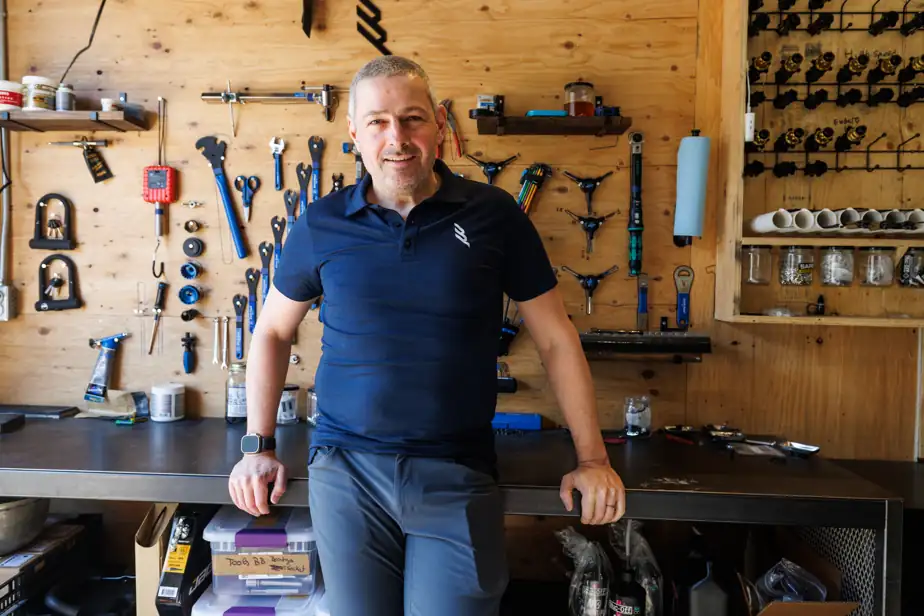
Benjamin’s background in tech includes his role as co-founder of Mobeewave, the fintech company behind contactless mobile payments, which was acquired by Apple in 2020. After that, he could easily have gone in search of the next digital unicorn, but he chose a different path. His ambition in recent years has been to handcraft, in Montreal, a bicycle designed to last for generations.
But Baumier’s innovation isn’t just in the product; it’s in the way he does business.
The problem: an industry, and even a society, out of touch with its values
For a founder like Benjamin, who has experienced hypergrowth and venture capital, the conclusion was clear: our society suffers from a capitalist drift that flattens people within organizations.
This is precisely what he observes in the cycling industry, where, on one hand, there is a community of enthusiasts deeply committed to physical effort, nature, and sustainability; and on the other, an industry dominated by major global players whose focus on volume directly contradicts the values of their own customers.
For Benjamin du Haÿs, this disconnect is the real problem to be solved, not only in terms of how to build a better bike, but also how to build a company whose practices align with what it claims to stand for.
He therefore decided to adopt the principles of Frédéric Laloux and his book Reinventing Organizations: Toward Inspired Work Communities to create a governance method based on the equatorial forest.
The Risk: An Alternative Model That’s Hard to Finance and Establish as Credible
Offering a high-end bicycle entirely designed, manufactured, and assembled in Montreal, complete with a lifetime warranty, bio-based resin, and governance inspired by the rainforest, is a bold move. And it’s also risky.
It took approximately $3 million in investments to bring the product to market. For a startup that rejects mass-production logic, every production decision, whether regarding materials or suppliers, must be justified not only technically but also financially.
Furthermore, since the company aims to remain small, with a long-term goal of producing about 200 bicycles and 200 sets of wheels per year, its model requires rigorous resource management. Navigating the tax credits and grants to which a young Quebec manufacturing company is entitled thus becomes a challenge.
At the same time, it’s a small price to pay to maintain control over Baumier’s governance model, where every employee has a say in business decisions. A stark contrast to the tech scene Benjamin experienced where return on investment was superior to sustainable growth.
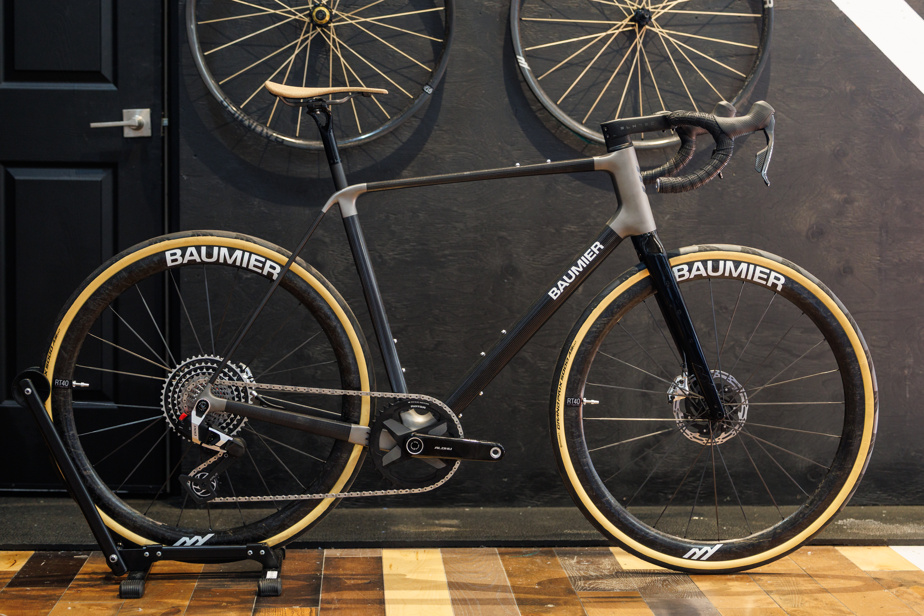
Meet the B01, Baumier's inaugural bike
A Recent Launch Grounded in Reality
Despite the risks, the B01 is now available for purchase. Designed, assembled, and manufactured entirely in Baumier’s Montreal workshops, it is an all-road bike with versatile geometry, available in five sizes. Its frame combines woven and unidirectional carbon tubes with 3D-printed titanium connectors.
Baumier is among the few brands in Canada to locally produce both carbon frames and wheels. As noted in a recent article in La Presse, the company aims to sell 40 to 50 bikes this year.
This launch is also supported by strategic business partnerships, notably with Arkel, a leading Quebec-based cycling equipment brand, which allow Baumier to expand its presence within the cycling community without compromising its niche positioning.
What Garage&co Set Out to Do
Working with Baumier, our task was to identify and secure the tax credits and grants available to support the company’s growth.
In a context where every dollar invested in R&D, local manufacturing, and process innovation can yield a significant tax return, one still needs to know how to navigate this administrative maze without wasting precious time.
For an entrepreneur like Benjamin, accustomed to rapid execution, rigor, and impact, the challenge wasn’t finding help. It was about finding it at the right time, with the right support, so that the capital deployed remains at the service of the product and the people who make it.
And as mentioned earlier, helping Benjamin and his team find financing options that align with his vision for Baumier.
Why Baumier Is a Change Maker
Baumier seeks to reinvent our relationship with what we buy, what we make, and how a company can embody its values at every stage of its value chain. This goes beyond the vision it envisions in bicycle design.
At Baumier, two pillars guide every decision: people and the environment. Designing a bike that honors these commitments means rethinking the entire chain, from local production to responsibility for the product’s full life cycle.
And in an ecosystem obsessed with rapid growth, Baumier reminds us that it is possible to build differently.
This is how true competitive advantage is expressed. Not through technology, because the bicycle remains a mode of transportation older than the car, but rather through the alignment between the product delivered and the people who work to produce it.